Lead sickness
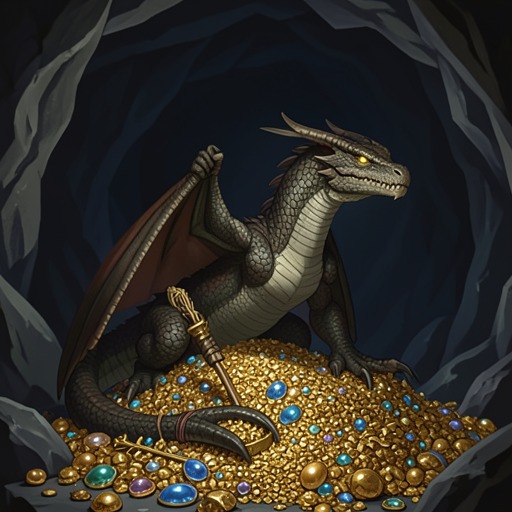
Vainqueur the DragonLead sickness is the name given to the condition afflicting Vainqueur Knightsbane’s gold after Furibon repeatedly transforms it into lead. It is not merely a financial loss: for Vainqueur, whose dignity, health, authority, and sense of what it means to be a dragon all depend on possessing a visibly magnificent hoard, lead sickness makes the dragon himself feel damaged. The condition therefore converts an attack on treasure into a personal and civilizational emergency, forcing Vainqueur to pursue Furibon not only for revenge but for the survival of the dragon way of life.
Origin and Magical Mechanism
Lead sickness begins when Furibon casts [Transmute Gold to Lead]. During their confrontation, the lich first identifies Vainqueur’s hoard on the bridge of the airship and raises the possibility of throwing it into the lava. Vainqueur’s immediate panic reveals that the gold is the battle’s decisive vulnerability. Furibon does not waste the treasure by destroying it. Instead, he uses purple lightning and dark magic to change the entire hoard from beautiful gold into dull, unshiny lead, leaving Vainqueur too shocked to process what has happened.
The curse is especially cruel because it preserves the hoard’s physical substance while destroying the quality that gives it meaning. Gold remains present, but its color, shine, and value have been stripped away. The transformation makes the treasure conspicuous as a failed object: something that still occupies space yet no longer performs its essential function in Vainqueur’s world. Furibon later repeats the same spell against a new payment of coins, turning them into lead with a flash of black magic. The recurrence establishes lead sickness as an active weapon rather than a single accident, and it allows Furibon to punish Vainqueur’s attempts to rebuild what was lost.
Symptoms and Meaning for Vainqueur Knightsbane
Vainqueur describes himself as sick because his gold is sick. When Victor Dalton points out that the silver, jewels, and magical items remain intact, Vainqueur rejects the consolation: a dragon’s hoard must contain gold, or it is not shiny enough. The distinction between gold and the rest of his assets is therefore absolute. The hoard is not valuable to him only because it represents wealth; gold is the material proof of draconic completeness, and its absence makes the remaining riches feel frozen rather than reassuring.
The condition also produces a psychological and behavioral change. Having no hoard worth bragging about becomes, for Vainqueur, worse than death. His earlier adventuring ideal of increasing the size of his hoard is exposed as dangerously incomplete, since the existence of threats capable of corrupting treasure matters as much as the acquisition of treasure itself. He becomes unusually intense and serious, frightening Victor, while narrowing his objectives to two remedies: recovering healthy gold and taking revenge on Furibon.
Vainqueur’s language expands the illness beyond his own injury. He declares that Furibon is a threat to all dragons and all hoards, present and future, comparing the danger to the ancient menace of the Gold-Eating Insects. The curse thus gives a private obsession a public rationale. Vainqueur still speaks in the language of possession and greed, but his campaign is recast as defense of a collective dragon inheritance.
Repeated Attacks and the Conflict with Furibon
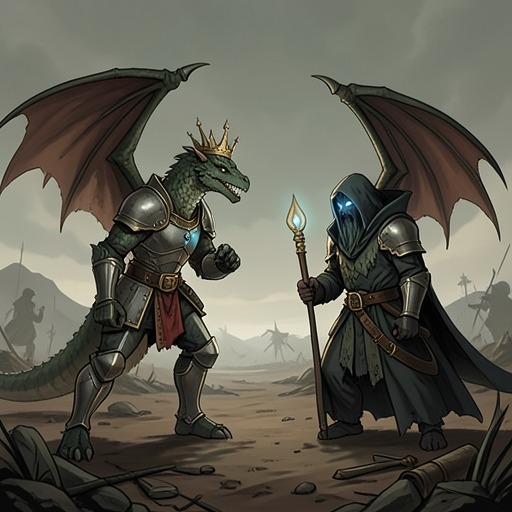
Furibon understands that gold is the point at which Vainqueur is most vulnerable. When Vainqueur invades the lich’s castle to stash or recover his treasure, Furibon objects that the dragon is trying to expel him from his own home. The conflict is consequently symmetrical: each hoard-owner treats the other as an invader, and each sees the other’s relationship to property as intolerable. Vainqueur attacks with fiery breath, while Furibon answers with spells including [Clock Stop], [Black Curse], and [Accelerated Superflare]; yet the most devastating attack remains the transformation of gold into lead.
The second use of [Transmute Gold to Lead] is timed against Vainqueur’s expectation of renewed prosperity. He calculates that income of four hundred coins per level would eventually produce forty thousand coins each month and nearly half a million each year. Before that imagined ocean of gold can become reality, Furibon changes the coins into lead. The spell therefore attacks not only accumulated wealth but also anticipated wealth, collapsing Vainqueur’s future at the instant he begins to imagine it.
Furibon’s motive is openly personal as well as tactical. After turning the coins, he explains that the act is punishment for Vainqueur’s destruction of his library and taunts him with the claim that silence is golden. The joke intensifies Vainqueur’s fury because it treats the dragon’s defining value as a punchline. Furibon’s hatred of gold eventually destroys him, making the curse structurally self-defeating: the same fixation that enables his attacks becomes the obsession through which he is defeated.
Cure and Consequences
The cure emerges from the interaction between Vainqueur’s abilities and Victor Dalton’s practical reasoning. Vainqueur recalls that he negated the lich’s spells with [Spell Purge], and Victor suggests that the same principle could cancel the transformation affecting the hoard. Vainqueur understands the implication before Victor finishes explaining it and realizes that he can cure lead sickness. The discovery restores the gold and saves the hoard after the crisis has seemed irreversible.
The cure changes the balance of the conflict. Furibon’s most effective means of injuring Vainqueur no longer guarantees permanent damage, while the destruction of the lich removes the source of the curse itself. The narrative presents Furibon’s defeat as a victory for greed in comic but consequential terms: Furibon, described as an enemy of all that is good, is destroyed by the hatred of gold that fueled his evil, and the dragon way of life endures.
Lead sickness also becomes part of Vainqueur’s political order. After Furibon’s defeat, Vainqueur’s second commandment forbids lead forever in the lands of Emperor Vainqueur. Anyone smuggling lead is to be eaten, except when the material is sickened gold, which must instead be cured and added to the imperial hoard for eternal safekeeping. The law converts a personal trauma into public doctrine. It preserves the memory of Furibon, criminalizes the substance associated with him, and places even corrupted treasure under imperial protection.
Relations, Debt, and Narrative Significance
The condition exposes how Vainqueur’s relationships are organized through treasure. He agrees to loan wearable magical items to Victor because the minion has proved reliable and because Vainqueur wants to keep him safe, but the gesture remains framed as a loan rather than a gift. Later, Vainqueur allows Victor and the Kobold Rangers to use weapons from the hoard only temporarily, insisting that Victor is the sole servant he fully trusts not to lose the sacred treasures. Lead sickness sharpens this possessiveness: damaged gold makes every remaining object more guarded, more visible, and more politically charged.
The same economy governs compensation. Vainqueur promises Victor a fee from corpse sales, then pays eight gold coins while insisting that this represents one one-tenth of the proceeds. His refusal to treat wealth as freely distributable contrasts with the villagers of Murmurin, whose donations later fund Victor Dalton’s revival. Vainqueur would not willingly part with coin even to restore his chief of staff, yet he demands that Victor repay a life debt of twelve million, five hundred forty-five thousand, one hundred thirty-three gold coins for his resurrection and service. Against this background, lead sickness is not an isolated magical ailment but the extreme form of a social system in which gold measures loyalty, authority, obligation, and survival.
The condition’s lasting significance lies in this fusion of material and symbolic stakes. Furibon’s spell makes Vainqueur’s treasure visibly useless, while the cure restores both the hoard and the purpose that Vainqueur had temporarily lost. His response never abandons greed; instead, greed is elevated into law, revenge, imperial ceremony, and a defense of dragons everywhere. Lead sickness therefore marks the point at which Vainqueur’s private hoarding becomes a public ideology, and at which Furibon’s attack on gold becomes the central engine of his own downfall.